
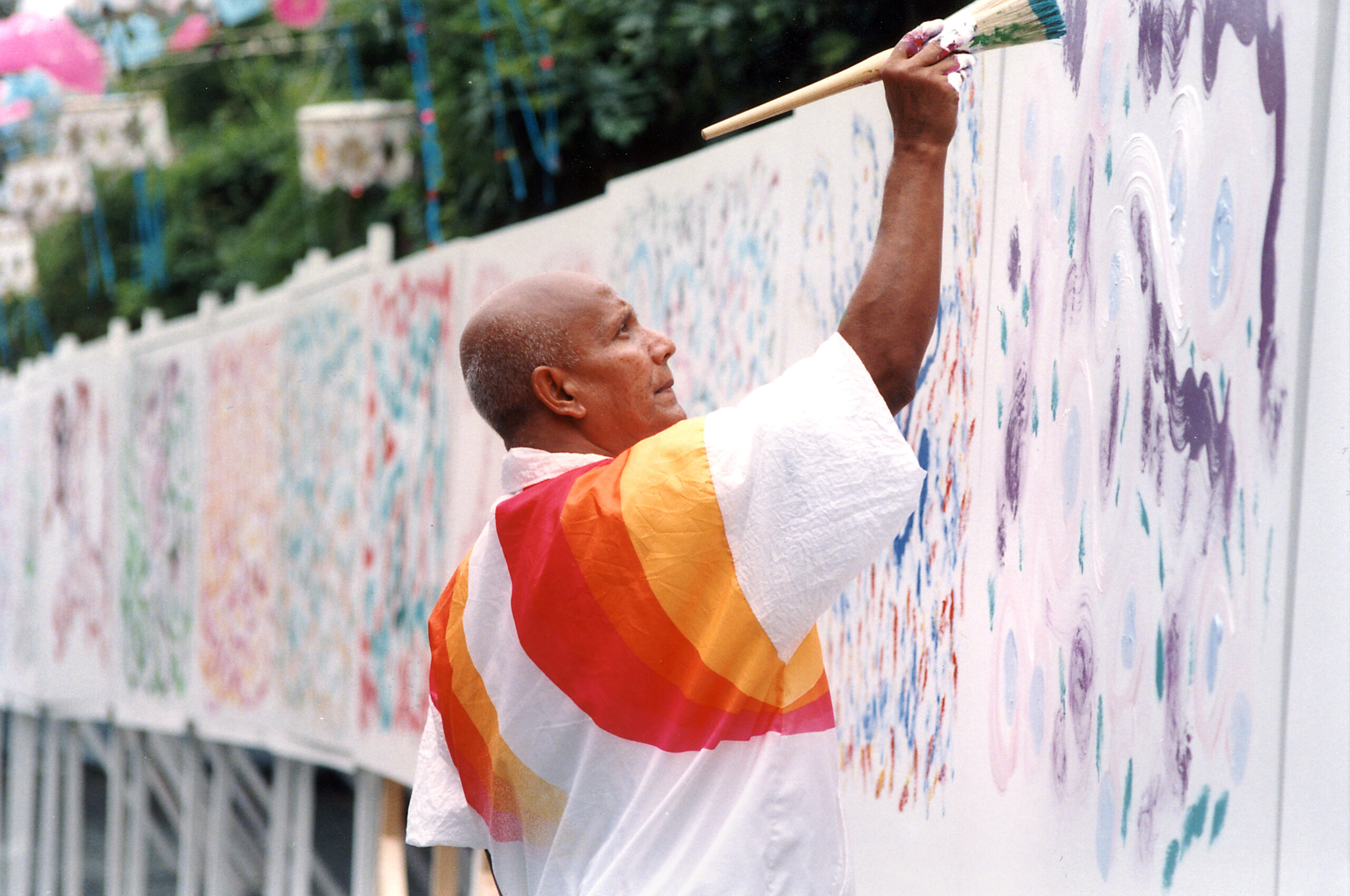
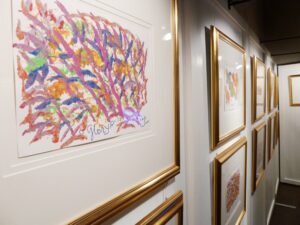
Sri Chinmoydeveloped his own original artistic style, which he called Jharna-Kala, which means“fountain of art”. The source of creative inspiration for these acrylic abstracts was the profound silence of contemplative consciousness, from which inner experiences welled up and were reflected in his extensive body of work. This spontaneous artistic style, characterized by a balanced harmony of light and color, captures the inner insight of the moment—from which speak a love for humanity, an experience of life’s harmony, a sense of beauty, and the joy of artistic creation. The artist himself describes his approach to his work as follows:
“While I paint, I do not use my mind, because the process of thinking binds us. I have nothing in my mind. I try to keep my mind as empty, idle, and calm as possible. The mind is like the surface of the sea. On the surface, the sea is filled with waves and turbulence; it is all restlessness. But when we dive deep, that same sea is all peace, calm, and silence, and there we find the source of creativity.”
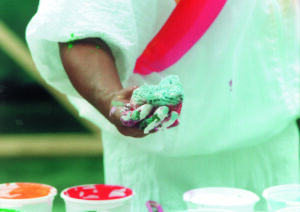 Sri Chinmoy developed his unique artistic style very quickly thanks to his indomitable creative energy. During his first year (1975), he painted more than 100,000 works, including 16,031 paintings created during a 24-hour “marathon.” His art is characterized by his characteristicspontaneity and playfulness. Although he often used traditional brushes for painting, he also made his own tools for applying paint from cotton or cut-up sponges.
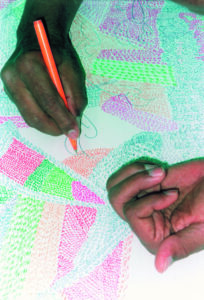 His extensive collection of artworks also includes a series of lyrical drawings of birds with the poetic titleDream-Freedom Peace-Birds, which represent a key motif in his work and symbolize the soul—the eternal essence of human existence. Many of these small depictions are incorporated into large, colorful mosaics, where they number as many as several thousand in a single work. These Zen-like simple, pure, and calligraphic strokes, executed using a variety of techniques—including watercolors, gouache, pastels, and colored pencils, contain an uplifting touch of aspiring consciousness, from which an inner experience of happiness, peace, and freedom speaks. The artist commented on this work as follows:
“Birds have a very special significance; they embody freedom. When we see a bird flying across the sky, it reminds us of our own inner freedom. Within each of us lies an inner reality in the form of the soul. The soul, just like a bird, flies through the inner sky of infinity.“
A selection of Sri Chinmoy’s most notable art exhibitions around the world
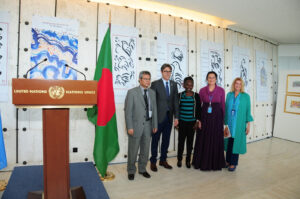
- 2017 United Nations, Palais des Nations/ Geneva
- 2008 European Parliament/ Belgium
- 2007 United Nations Secretariat Building / New York, USA
- 2006 Kunstlerhaus Vienna/ Austria
- 2006 Miro Gallery/ Prague, Czech Republic
- 2006 Carrousel Du Louvre / Paris, France
- 2006 UNESCO / Paris, France
- 2005 Carrousel Du Louvre / Paris, France
- 2005 Art Gallery / London, UK
- 2004 Agung Rai Museum/ Ubud, Bali
 2004 Diaghilev Art Center for the Museum of Modern Art at the Smolny Institute of Free Arts and Science / St. Petersburg, Russia
- 2004 Jawaharlal Nehru Cultural Center /Indian Embassy /Moscow, Russia
- 2004 Museum of East and Westt /Odessa, Ukraine
- 2004 Art Museum / Kharkiv, Ukraine
- 2003 The Academy of Art and Science/ Skopje, Macedonia
- 2001 Town Hall / Reykjavik, Iceland
- 2001 Oslo City Hall / Oslo, Norway
- 2000 United Nations Secretariat Building / New York, USA
- 1999 Empire State Building, Fifth Avenue Gallery / New York, USA
- 1998 University of Washington / Seattle, USA
- 1998 Il Saggiattore / Rome, Italy
- 1997 Cambridge Central Library /UK
- 1996 Ruzyně International Airport/ Prague, Czech Republic
- 1996 Val Arts Gallery / London, UK
- 1995 Russell Rotunda/ U.S. Senate /Washington, DC
- 1995 University of Adelaide /Australia
- 1995 Senate Foyer, Parliament House / Canberra, Australia
- 1995 Sydney Opera House / Sydney, Australia
- 1994 The Mall Galleries /London, UK
- 1993 John F. Kennedy International Airport / New York, USA
- 1993 Museum of Modern Art / Manila, Philippines
- 1993 Palais des Rols de Majorque / Perpignan, France
- 1993 Shinjuku Kuritsu Kumin Citizen’s Gallery / Tokyo, Japan
- 1993 Peace Osaka Hall / Osaka, Japan
- 1992 The Espace Miro/ UNESCO /Paris, France
- 1991 Unison Gallery / New Paltz, USA
- 1989 The State House / Boston, USA
- 1989 Niska Gallery / Montreal, Canada
 1987 Oneness-World Gallery / Zurich, Switzerland
- 1986 Gallerie in der Fasanen Strasse/Berlin, Germany
- 1986 Horizon Gallery / London, UK
- 1984 Centro de Bellas Artes / Maracaibo, Venezuela
- 1983 Galery Scholossgasse / Zurich, Switzerland
- 1980 Museum Alexander Koenig/ Bonn, Germany
- 1980 National Arts Centre / Ottawa, Canada
- 1979 National Visitors Center / Washington, USA
- 1978 Commonwealth Institut / London, UK
- 1978 Musee des Beaux-Arts / Montreal, Canada
- 1978 Harvard University / Massachusetts, USA
- 1977 Museum of Man / Ottawa, Canada
- 1976 Carnegie Hall / New York, USA
- 1975 OSN Secretary Building / New York, USA
- 1975 Columbia University / New York, USA